
A public library not only serves its original purpose of collecting, organizing, preserving, and accumulating materials but also should provide information to local residents in a convenient and accessible manner. It should create an information environment that satisfies the information acquisition needs of all layers of the population. Additionally, it should remain faithful to its role as a venue for lifelong education, ensuring no neglect in providing cultural and artistic information, events, and more.
The role of a library
A public library not only serves its original purpose of collecting, organizing, preserving, and accumulating materials but also should provide information to local residents in a convenient and accessible manner. It should create an information environment that satisfies the information acquisition needs of all layers of the population. Additionally, it should remain faithful to its role as a venue for lifelong education, ensuring no neglect in providing cultural and artistic information, events, and more.
"(Kim, Sunae. A Study on Deriving Standards for the Operation of Public Library Spaces. The Korean Journal of Bibliography, Vol. 19, No. 2, 2008)"
The necessity of acoustic performance standards for libraries
Libraries are composed of various spaces, such as reading rooms, book stacks, meeting/discussion areas, exhibition spaces, and performance areas. Each space requires specific acoustical performance standards tailored to its intended use.
Reading rooms and book stack areas require acoustical performance levels similar to office spaces, while meeting/discussion spaces need performance levels equivalent to meeting rooms. Exhibition spaces should adhere to Open Space standards, and performance areas should follow acoustical standards for auditoriums to achieve satisfactory sound levels according to their respective purposes.
A well-designed indoor acoustical environment,
- aids decision-making and reduces the likelihood of errors by workers.
- promotes interaction and enhances overall satisfaction with the space.
- It attracts and retains talent.
In spaces with poorly designed acoustics, user concentration and productivity are compromised.
- In noisy and distracting environments, workers experience an 86-minute decline in daily productivity.(steelcase, lpsos : 2014)
- Students exposed to continuous noise experience a decline in reading comprehension and delayed cognitive development. (Cambridge Univ. 2009 / Cornell Uni. 1993)
The ABCDs of Indoor Acoustic Management
To achieve the acoustic performance goals of the library, we need to consider four key strategies: A, B, C, and D. However, given the recent trend in interior design favoring Open Space layouts, there is limited opportunity to apply effective sound insulation in actual indoor spaces. Consequently, it is crucial to strategically implement sound absorption measures that will have the most significant impact on the occupants of the space.
ABSORB "Absorbs Sound"
BLOCK "Blocks Sound"
COVER "Cover Sound with Sound"
DIFFUSE "Evenly Distribute the Sound"
Korean Acoustic Performance Standards
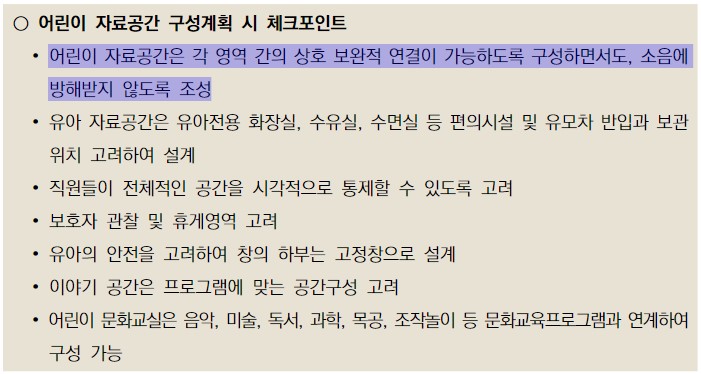
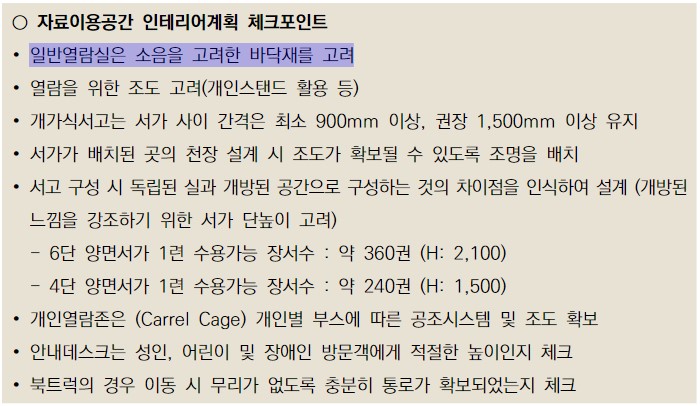
The 2022 Public Library Construction and Operation Manual from the Ministry of Culture, Sports, and Tourism includes information on some aspects of acoustic design. For instance, it mentions that "the children's resource area should be designed to prevent disturbance from noise." However, the document lacks specific quantitative values, making it challenging for these guidelines to be practically applied in real-world situations.


International Acoustic Performance Standards
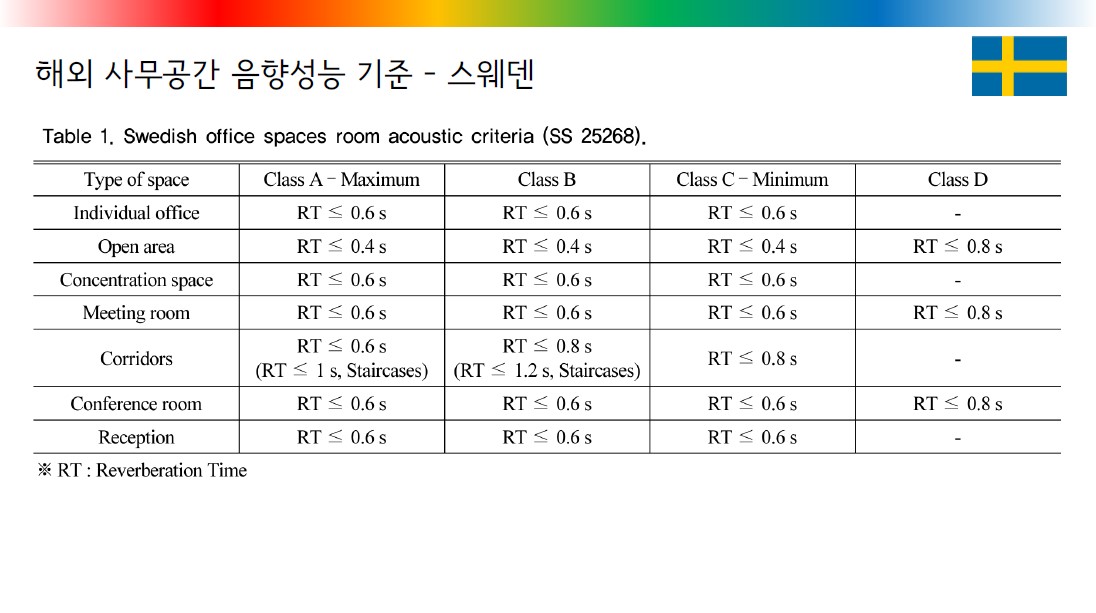
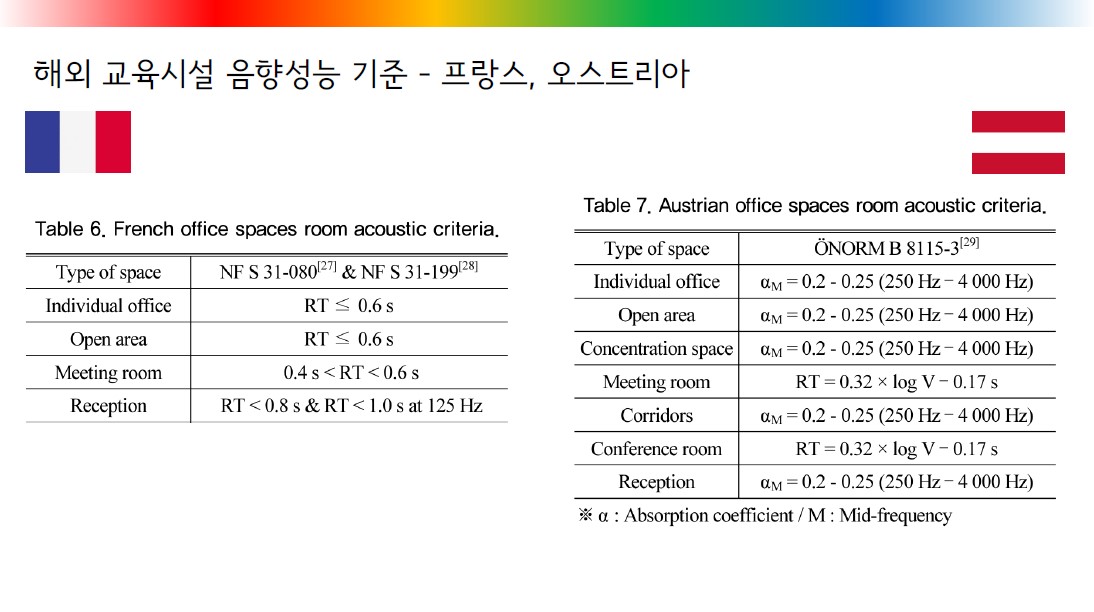
Internationally, there are very specific and practical acoustic performance standards for various types of spaces. In particular, guidelines are provided that specify the acoustic performance, especially in terms of absorption, which significantly affects the occupants of the space.
As observed earlier, there are currently no specific acoustic design guidelines in place domestically.
As South Korea has undeniably joined the ranks of advanced nations, it would be desirable for domestic libraries to recognize that sound, though not a visible design element, is a factor that significantly influences user concentration, productivity, and well-being. It would be beneficial if this awareness is reflected in the design process.

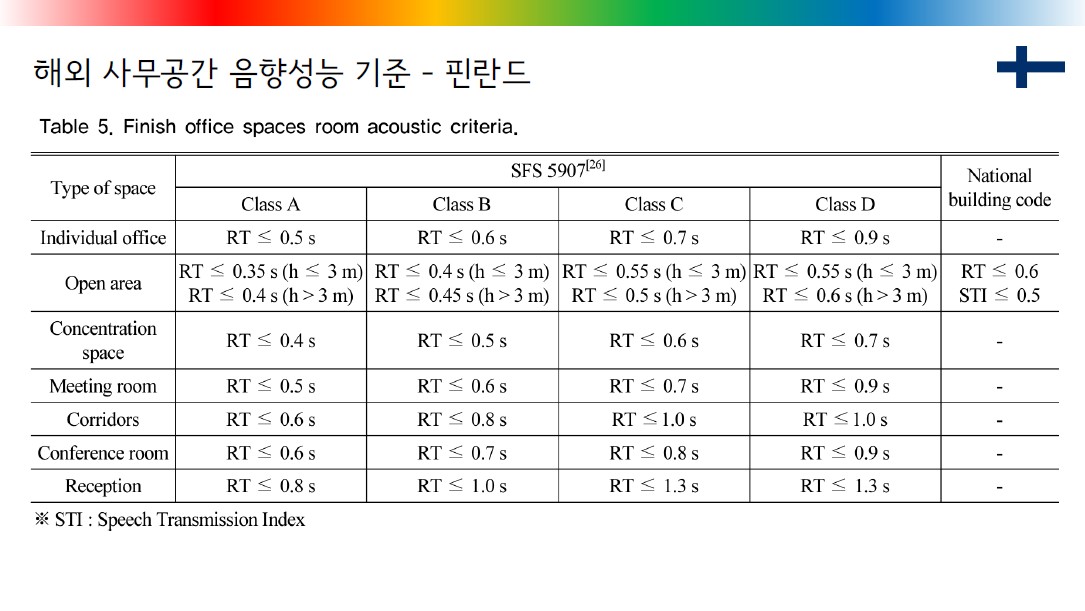
Partial content of this information has been quoted from Dr. Jeong-Ho Jung's presentation materials at the National Disaster Safety Institute.
Questions for Identifying a Quality Interior Design Company
In the current situation where there are no existing guidelines for acoustic design in domestic libraries, even so, when selecting an interior design company to create an acoustically favorable library, it would be helpful to refer to the following questions or requests. Applying acoustics doesn't necessarily entail a significant increase in costs, so there's no need to worry excessively about the budget.
Before selecting an interior design and construction company, asking the following questions in advance can significantly increase the likelihood of achieving better acoustic results. While achieving all four steps (1 > 2 > 3 > 4) might be challenging, even considering the first step can yield much better outcomes than not considering any acoustic aspects at all.
1. Are you identifying and designing the space from an acoustic perspective?
- Even just distinguishing the interior space into noisy areas, quiet areas, and mixed spaces before the design process can lead to good results.
- Identifying the space acoustically and zoning make it easier to assess soundproofing and absorption for each area."
2. Are you taking into consideration or aware of the target reverberation time for each room?
- Ask whether they are aware of and considering appropriate target reverberation times for each specific purpose within the indoor space.
- Confirming the target reverberation time is generally not a difficult task, and designs that take this into account can make a significant difference compared to those that do not.
3. What are the target noise level limits you are aiming to achieve, in terms of decibels (dB), for various types of noise?
- Check if there is consideration for the maximum allowable background noise levels based on exposure to internal or external noise.
- Inquire about any plans in place to reduce impact noise, ensure speech privacy, and mitigate noise stress.
4. Can the set criteria and standards be demonstrated through measurements after the construction is completed?
- Verify if it is possible to measure maximum noise levels, sound transmission loss, reverberation time, and background noise.
Interested in the products discussed in this article?
View Product → PET Acoustic Panel자주 묻는 질문(FAQ) — 도서관 음향성능기준
Q. 도서관의 권장 잔향시간(RT60)은 얼마인가요?
A. 공공도서관 및 열람실의 주 열람 공간 권장 RT60은 0.4~0.6초입니다. 이는 사무실(0.4~0.5초)과 교실(0.5~0.7초)의 중간 수준입니다. RT60이 너무 짧으면 공간이 불쾌하게 "죽은" 느낌을 주고, 길면 독서 집중력을 방해하는 에코가 발생합니다. 공식 측정 기준은 KS F 2863 및 ISO 3382-1을 따릅니다.
Q. 도서관 인테리어에 적합한 흡음 소재는 무엇인가요?
A. 도서관에는 일반적으로 천장 흡음 패널(유리면/암면 타일, NRC 0.70~0.90), 벽면 PET 또는 목모보드(NRC 0.50~0.90), 카펫 바닥재(NRC 0.20~0.40)의 조합이 효과적입니다. 특히 목모보드는 자연스러운 미감과 구조적 내구성으로 도서관에서 인기가 높습니다. 공공건물인 만큼 방염 등급(1급) 준수 여부도 선택 기준에 포함해야 합니다.
Q. 국내 공공도서관 음향 기준이 별도로 있나요?
A. 네, 국내 공공도서관 음향 요건은 「도서관법」 및 관련 시설기준에서 참조됩니다. 배경소음은 NC-35(약 45 dBA)을 초과하지 않아야 합니다. 신축 및 대규모 리모델링 시 음향 성능 기준이 시설 승인 조건으로 강화되는 추세입니다. 국제 참조 기준으로는 ISO 11690(작업장 소음)과 IFLA 도서관 설계 가이드라인이 있습니다.
Q. 도서관 음향 공사 업체를 어떻게 평가하나요?
A. 도서관 음향 설계·리모델링 업체 선정 시 확인해야 할 핵심 질문: ①제안 소재에 대한 공인 NRC 시험성적서(KCL/FITI) 제출 가능 여부? ②시공 전 음향 측정(RT60, 배경소음)을 실시하고 시공 후 검증 보고서를 제공하는지? ③유사 공공도서관 시공 실적이 있는지? 시공 전후 음향 측정 데이터가 포함된 사례 자료를 요청하세요.
Q. 층고가 높은 도서관에서 에코가 심한 이유는 무엇인가요?
A. 5m 이상의 층고가 높은 도서관은 큰 공기 부피로 인해 잔향시간이 길어지기 쉽습니다. 콘크리트, 유리, 석재 같은 딱딱한 마감재는 흡음 없이 소리를 반사합니다. 책장이 평행 배열되면 플러터 에코도 악화됩니다. 해결책으로는 현수형 음향 클라우드, 서가 사이 벽 패널 설치, 열람 공간 전체 카펫 시공이 효과적입니다.